

25 November 2025
Algocell Releases New Digital Twin Case Study for Pichia pastoris Optimization
Algocell has released a technical case study detailing the optimization of Pichia pastoris precision fermentation using hybrid mechanistic-ML digital twins. The study demonstrates how the platform accelerates bioprocess development to increase protein yield while reducing the required number of experiments.
Bioprocess Development via iDoE
The project utilized an intensified Design of Experiments (iDoE) to map the process design space efficiently. This approach allowed for the calibration of a digital twin using a short set of experiments – four runs in total- to capture complex biological data, including biomass growth kinetics, substrate uptake rates, and AOX1 induction logic.
The digital twin was validated against unseen calibration runs and historical customer data to ensure predictive accuracy before generating new protocols.
Performance Results and Protocols
The platform produced two distinct feeding strategies designed to maximize total protein output and time-normalized productivity:
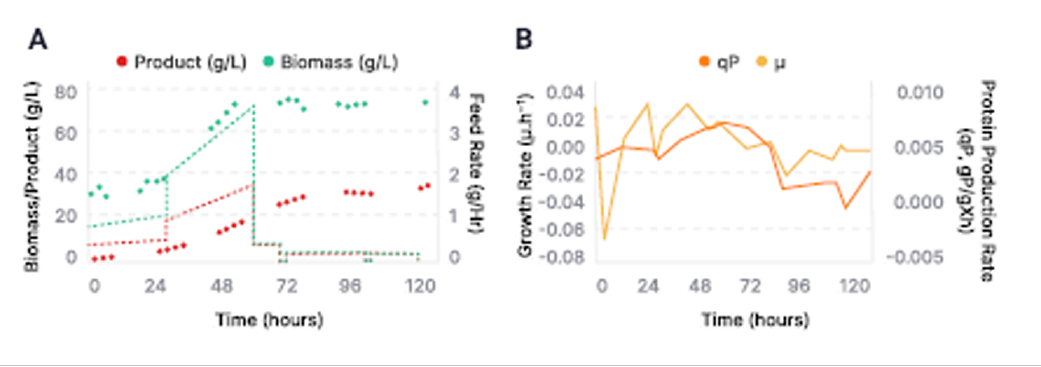
Optimized Fed-Batch Protocol: This protocol uses a stepwise exponential feed and is predicted to increase protein expression by 20% relative to historical controls.
Continuous/Harvest Protocol: This strategy employs repeated exponential steps with partial harvests to sustain growth-production coupling, resulting in a predicted 40% increase in yield.
Model Precision: The digital twin achieved high statistical accuracy, with a Mean Absolute Percentage Error (MAPE) for product titer as low as 3.8% in certain historical data fits.
Engineering and Operational Constraints
The generated protocols account for specific biological and engineering limits to ensure they are actionable in a lab environment. These constraints include pump rate ranges, aeration capacity, harvest cadences, and the avoidance of glycerol repression to maintain AOX1-compatible induction.
The full results, including the iDoE design-space mapping and detailed performance tables, is available in the complete case study. (HYPERLINK case study to download link)