Research Report
Adoption accelerates as integration barriers persist
By Eli Saati-Bernstein, Avi Nowitz (Algocell), Sasha L. Slobodsky, Ben Reznikov, Ari Hakimian
Biomanufacturers are transitioning from evaluating AI to embedding it directly into development workflows.
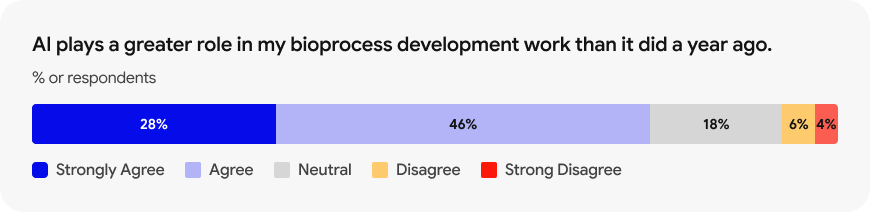
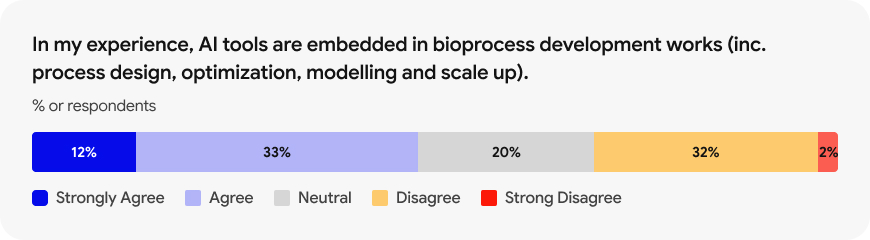
A new UC San Diego–Algocell survey of 124 bioprocess development professionals reveals a widening gap between executive expectation and operational reality. While 74% of survey respondents report year-by-year growth in AI use, only 45% have achieved true workflow integration.
Operational success is currently bottle-necked by fragmented tool sourcing, poor data readiness, and a lack of internal expertise. Navigating this transition will require organizations to shift focus from acquiring tools to structuring data and upskilling their existing workforces.
The survey was conducted among 124 bioprocess-development professionals between May and June 2026. Respondents included bioprocess engineers, researchers, and scientists located across the Americas, Asia, and Europe. Survey results reflect respondents’ reported experiences and perceptions and should not be interpreted as representing the entire biomanufacturing industry. Percentages may not total 100% because of rounding and, where applicable, multiple-response questions.
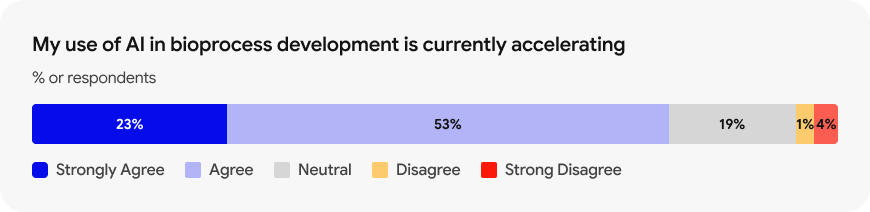
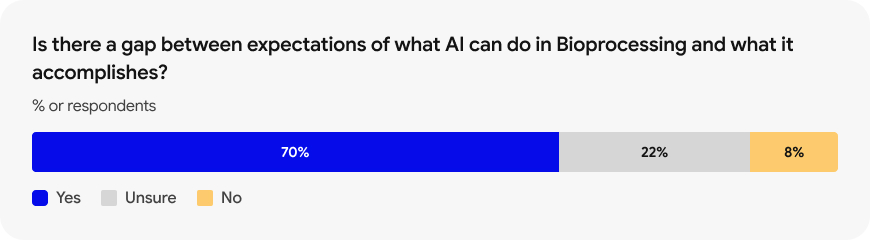
While 76% of respondents state their use of AI is accelerating, 70% report a clear gap between what AI is expected to do and what it actually accomplishes. Only 7% believe AI is fully meeting expectations.
In an industry governed by strict regulatory frameworks and traditional development pathways, process engineers are slow to alter validated workflows even if there is a top-down corporate mandate to use AI.
A disconnect exists between the pressure to adopt AI and the value realized on the ground
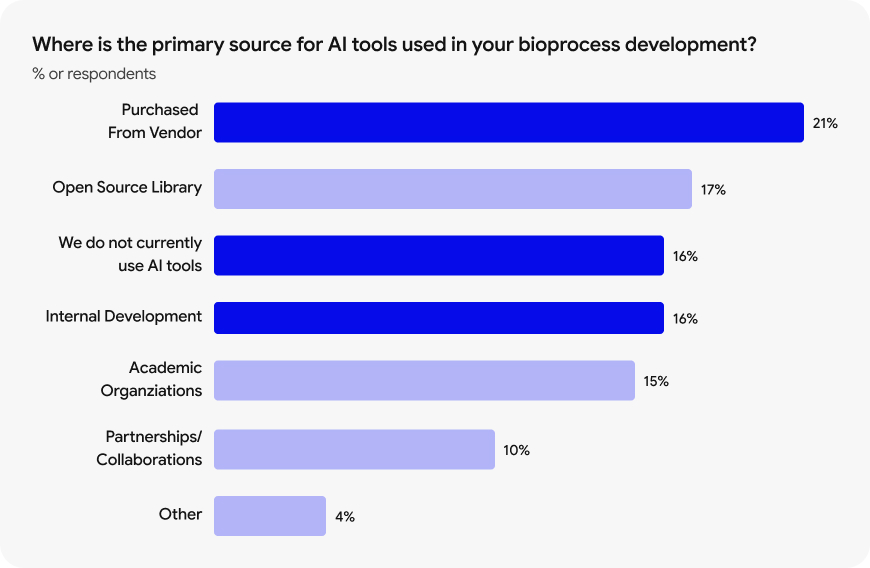
Commercial vendors account for only 21% of primary AI tools, with the remaining software split across open-source, academic, and partnership channels. There is currently no single dominant market leader or tool source in the bioprocessing space.
Furthermore, only 16% of organizations develop their tools internally, matching the exact percentage of companies that do not use AI tools at all. This indicates that the vast majority of the industry relies heavily on external software development rather than building proprietary systems.
Biomanufacturers rely primarily on external channels rather than developing proprietary software in-house
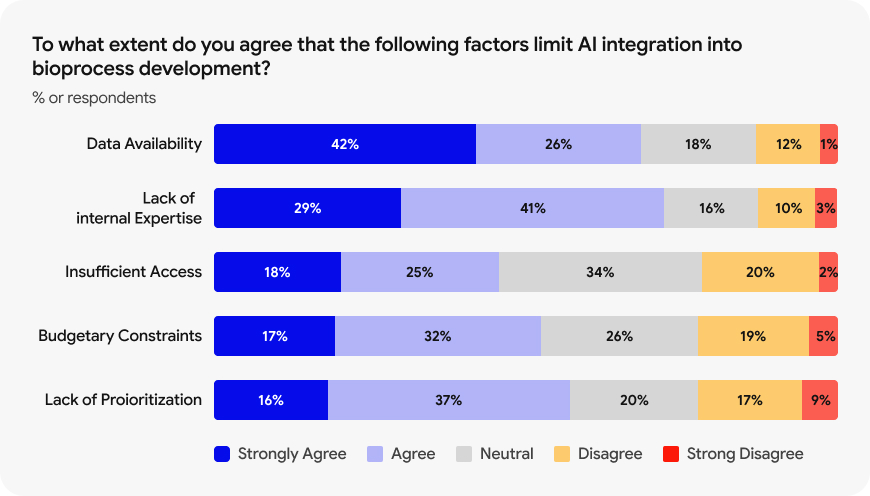
Survey respondents identify insufficient internal expertise (70%) and poor data availability (68%) as the primary barriers limiting AI integration. It is likely that existing data sources are disorganized and siloed.
Furthermore, 53% agree that a lack of prioritization acts as a critical strategic bottleneck.
Poor data availability and a lack of internal expertise are major barriers to AI integration
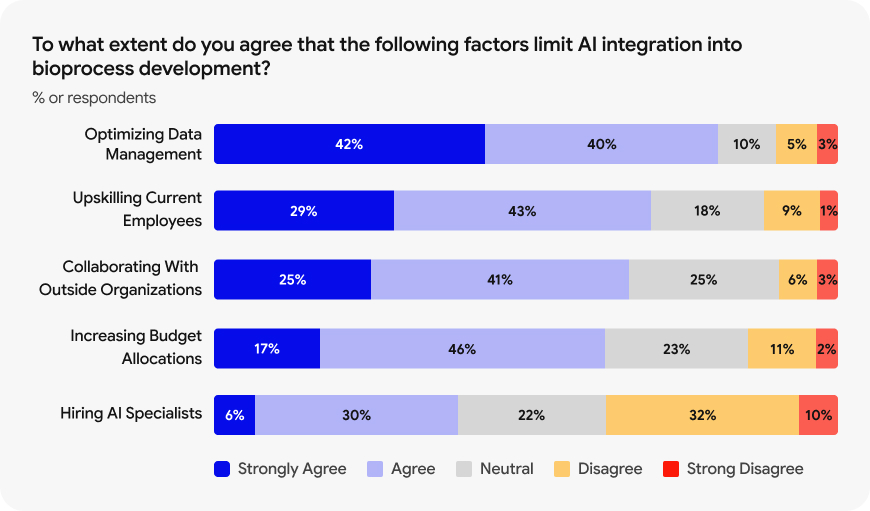
To facilitate integration, 72% of respondents favor upskilling current staff, while only 36% support hiring dedicated AI specialists.
This confirms that the workforce strategy centers on embedding AI skills within existing domain expertise, while the top operational priority remains optimizing data management (82% agreement).
Organizations prioritize training existing employees over recruiting data scientists.
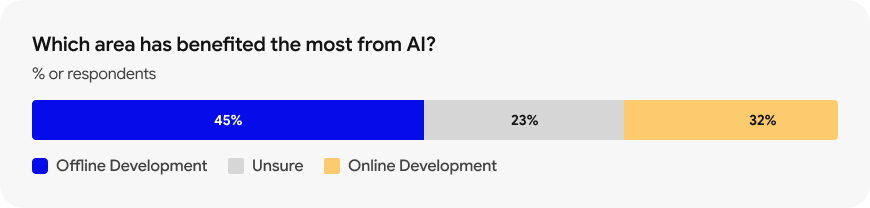
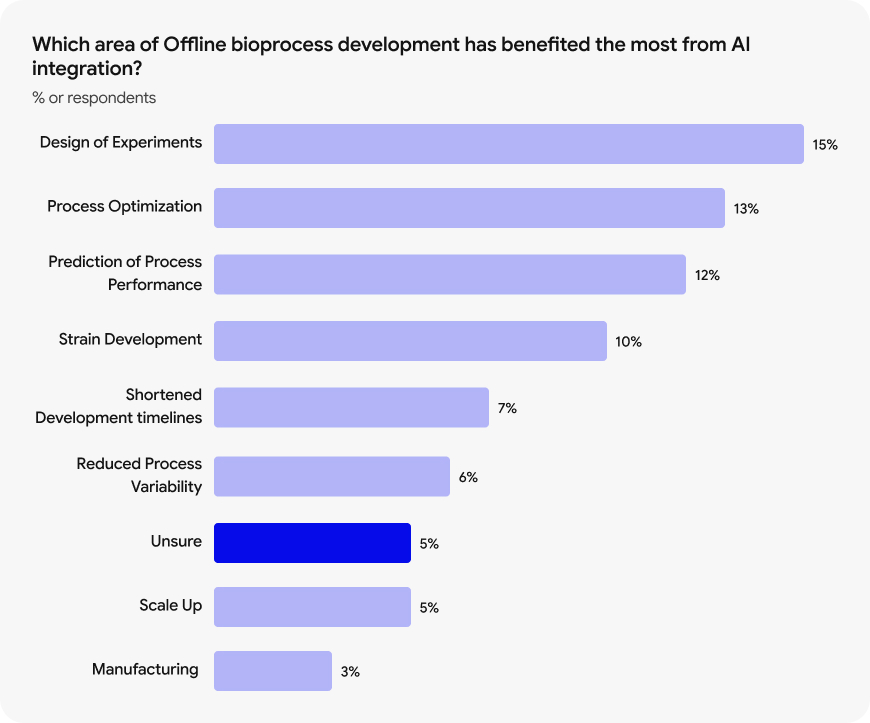
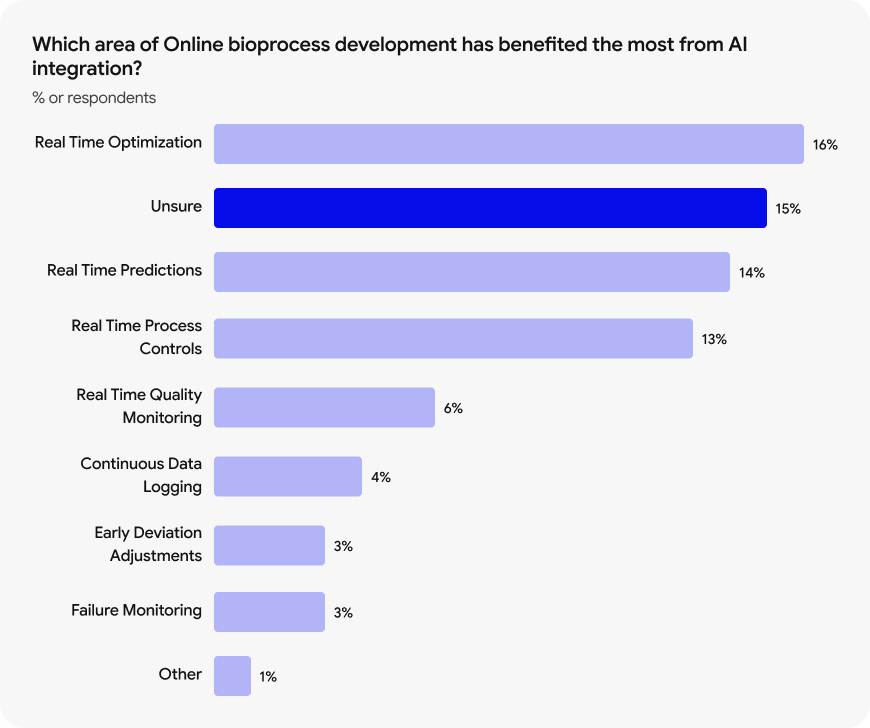
Offline development has benefited significantly more than online, leading 45% to 32%.
Early AI benefits are concentrated in offline applications where value is more certain.
In offline workflows, benefits are highly distributed, led by Design of Experiments (15%), Process Optimization (13%), and Prediction of Process Performance (12%).
Strain development (10%) already benefits from established AI tools, while historically underdeveloped offline areas are experiencing rapid, simultaneous growth.
In online workflows, applications are led by Real-Time Optimization (16%) and Real-Time Predictions (14%). However, because online applications carry a high "uncertainty rate" (15% unsure), organizations are effectively testing multiple systems simultaneously without established metrics for tracking return on investment.
Early AI benefits are concentrated in offline applications where value is more certain.
There is no single dominant platform or industry-standard software vendor in the market. Instead, teams pull from a highly fragmented landscape of tools. Commercial vendors account for roughly a fifth of the primary software used, with the remainder of the industry drawing from open-source libraries, academic software, and joint development partnerships.
Most companies choose to leverage external software or existing open-source frameworks rather than developing proprietary tools internally. Only a small minority of organizations build their AI applications in-house, a figure that matches the number of companies using no AI tools at all. Developing custom machine learning models internally requires substantial resources, making external sourcing the preferred approach.
Offline development applications deliver the most predictable and reliable results. Nearly half of process professionals report that offline workflows see the greatest benefit, specifically within Design of Experiments (DoE), process optimization, and predicting process performance. In contrast, online real-time optimization and automation systems carry high uncertainty, with many teams still unsure where real-time tools provide concrete advantages.
The primary bottlenecks to successful deployment are internal readiness and strategic focus, rather than the technology itself. Implementation typically stalls due to a lack of internal expertise to run the software and poor data availability caused by disconnected or unorganized data systems. Furthermore, over half of deployment efforts are slowed down simply because leadership mandates AI adoption without actively allocating dedicated project time or clear performance metrics to the engineering team.
No. The industry strongly favors upskilling existing engineering teams over recruiting external machine learning specialists. Because process development requires deep biological domain knowledge, it is far more practical to train existing process engineers on basic AI software than it is to teach complex bioprocessing workflows to generalist data scientists. The most effective path to integration relies on training current employees while focusing heavily on better data management.
Standalone Large Language Models (LLMs) generate responses based on language patterns rather than physical laws, making them fundamentally unsuited for complex, multi-step calculations like dynamic feeding profiles. To deploy them safely, GenAI should never act as an independent decision-maker. Instead, it must serve as a conversational interface layered over validated mathematical and hybrid process models. This allows engineers to use natural language to query data and set up simulations, while the underlying physical model acts as a safeguard to verify that all recommendations fit within actual equipment and biological limits.
To ensure a successful deployment, process development teams should evaluate software vendors against four practical checkpoints:
Hybrid Architecture: Avoid purely data-driven "black box" machine learning models, which require massive datasets and can output physically impossible predictions. Prioritize hybrid tools that constrain predictions within mechanistic physical laws (such as mass and energy balances).
Data Ingestion and Contextualization: Assess how easily the tool unifies and structures disconnected data from different runs, bioreactors, and historical files. A tool that requires manual data cleaning or brittle custom data pipelines will stall on the ground.
Operational Accessibility: Ensure the software is designed for process engineers and scientists rather than data scientists. The interface must allow your existing team to query, run simulations, and analyze results without needing to write custom code.
Compliance and Validation Readiness: For clinical or commercial workflows, select platforms built with GxP compliance, data integrity standards, and audit trail capabilities (such as 21 CFR Part 11) to avoid validation bottlenecks down the road.

Welcome to Algocell (“we,” “our,” or “us”). By accessing or using our website www.algocel.ai, you agree to comply with and be bound by the following Terms of Use. Please read these terms carefully. If you do not agree with them, you should not use this website.
To the maximum extent permitted by law, Algocell and its affiliates shall not be liable for any damages, including indirect, incidental, consequential, or punitive damages, arising out of your use or inability to use this website.
Our website may contain links to third-party websites. We do not control or endorse these external sites and are not responsible for their content or privacy practices.
If you have any questions regarding these Terms of Use, please contact us:
Algocell
Email: contact@algocel.ai
Website: www.algocel.ai
Algocell (“we,” “our,” or “us”) respects your privacy and is committed to protecting your personal data. This Privacy Policy explains how we collect, use, disclose, and safeguard your information when you visit our website www.algocel.ai.
We may collect the following types of personal data:
We use your personal data to:
We process personal data under the following legal bases:
We do not sell your personal data. We may share information with:
We retain your personal data only as long as necessary for the purposes set out in this policy, unless a longer retention period is required by law.
You have the right to:
Algocell uses cookies and similar technologies to improve your browsing experience and analyze site traffic. You can control or disable cookies through your browser settings. For more information, see our [Cookie Policy].
We implement appropriate technical and organizational measures to protect your personal data from unauthorized access, alteration, disclosure, or destruction.
If personal data is transferred outside the European Economic Area (EEA), we ensure adequate safeguards are in place, such as Standard Contractual Clauses approved by the European Commission.
If you have any questions about this Privacy Policy or your data, please contact us at:
Algocell
Email: contact@algocel.ai
Website: www.algocel.ai