
August 18, 2025
Algocell Releases New Digital Twin Case Study for Mammalian Cell Perfusion Optimization
Algocell has released a new technical case study detailing the application of its digital twin framework to optimize animal-cell proliferation in perfusion bioreactors. The study focuses on how hybrid mechanistic-ML models can be calibrated with limited data to provide actionable operating guidance for cultivated meat workflows and other biomass-intensive applications.
Efficient Design-Space Mapping
The project utilized a short series of calibration experiments to map critical process parameters, such as metabolic behavior and nutrient uptake rates. By using fed-batch runs to train the model, Algocell was able to predict performance in more complex perfusion systems.
The hybrid model combines a mechanistic core – grounded in mass-balance logic consistent with mammalian metabolism—with data-driven components to account for flexible kinetics. Key variables tracked include:
Biomass Growth Kinetics: Modeling cell expansion and viability dynamics.
Metabolic Profiles: Tracking glucose and glutamine uptake alongside the accumulation of inhibitory byproducts like lactate and ammonium.
Operational Constraints: Incorporating physical limits such as working volume, pump ranges, and oxygen transfer capacity.
Performance Validation and Results
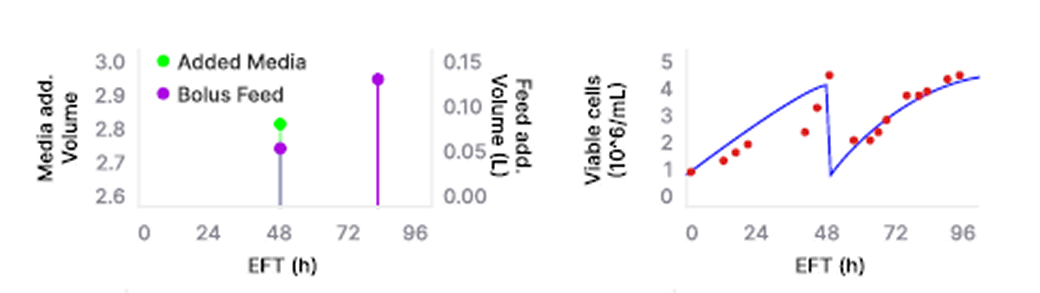
The digital twin was validated using a “blinded run” approach, where the model was trained on two experiments and tested against a third, unseen run. The model successfully reproduced metabolite and viable-cell trajectories with high statistical accuracy:Model Accuracy: Validation runs showed an average Mean Absolute Percentage Error (MAPE) of 12.12% for glucose and 14.78% for viable cell density.
Yield Improvement: Algocell’s platform-generated optimized protocol is predicted to deliver a 2.3-fold increase in biomass yield compared to the original manual perfusion protocol.
Optimized Strategies: The platform produced specific playbooks for perfusion rates, bolus feeds, and media rejuvenation schedules to maximize media conversion efficiency.
Strategic Outcomes
The case study highlights a significant reduction in the experimental burden typically required for process development. By providing a deeper understanding of cell-line behavior through in-silico simulation, the framework enables easier tech transfer and scale-up to complex engineering systems with fewer physical trials.
The complete case study, including detailed error metrics and protocol comparison charts, is available in the complete case study. (HYPERLINK case study to download link)